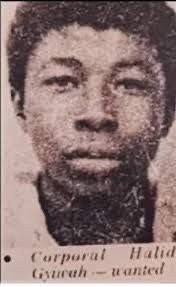
Halidu Giwa occupies a contentious place in Ghana’s military and political history, particularly during the turbulent period of the late 1970s and early 1980s. He was among the soldiers who aligned closely with Flight Lieutenant Jerry John Rawlings during the June 4, 1979 uprising and the December 31, 1981 coup that brought Rawlings and the Provisional National Defence Council to power. During this period, Giwa was considered part of the revolutionary inner circle that supported the overthrow of earlier governments.
By 1983, relations between Giwa and the PNDC leadership had deteriorated sharply. Giwa and other disaffected soldiers accused the Rawlings-led government of abandoning the ideals that had justified the revolution. They argued that the PNDC preached discipline and probity while failing, in their view, to practise those same values. These grievances formed the background to a planned armed challenge against the regime.
On June 19, 1983, Corporal Giwa led a group of rebel soldiers in an attempted coup against the PNDC. Some of the group were reportedly based in neighbouring Togo. The operation involved coordinated attacks on prisons in Accra and Nsawam, with the aim of freeing political detainees. During the same operation, Giwa and his supporters seized control of the Ghana Broadcasting Corporation. From the studios, Giwa announced that the PNDC government had been overthrown and declared himself the Operational Commissioner of what he described as Revolutionary Fighters.
The declaration proved premature. Loyalist forces moved swiftly to counter the uprising. Units loyal to the PNDC, led by Captain Courage Quashigah, advanced on the GBC premises. After a gun battle, control of the broadcasting station was retaken and the coup attempt effectively collapsed.
Giwa fled following the failure of the operation but was later captured by state security forces. In 1984, he was executed alongside other alleged conspirators, including Lance Corporal Sarkodie Addo. The executions were carried out during a period marked by intense internal security measures and political repression. Accounts of Giwa’s death describe it as particularly brutal, though official records from the period are limited.
Years later, Giwa’s arrest, detention and execution became part of the public record during hearings of the National Reconciliation Commission in the early 2000s. The commission examined human rights abuses committed under successive military regimes, including the PNDC era. Testimonies relating to Giwa’s death highlighted lingering questions about due process, the treatment of coup suspects, and the broader climate of fear that characterised that period of Ghana’s history.
Halidu Giwa’s story remains emblematic of the internal fractures within Ghana’s revolutionary movements and the violent struggles for power that defined the era. His role and fate continue to be debated in historical and reconciliation discussions, reflecting unresolved tensions about accountability and justice during military rule.